
Not the most used note — but one of the most deliberate.
Holding a specific niche within the United States monetary system, the 50 dollar bill serves as a bridge between common circulation and high-value storage.
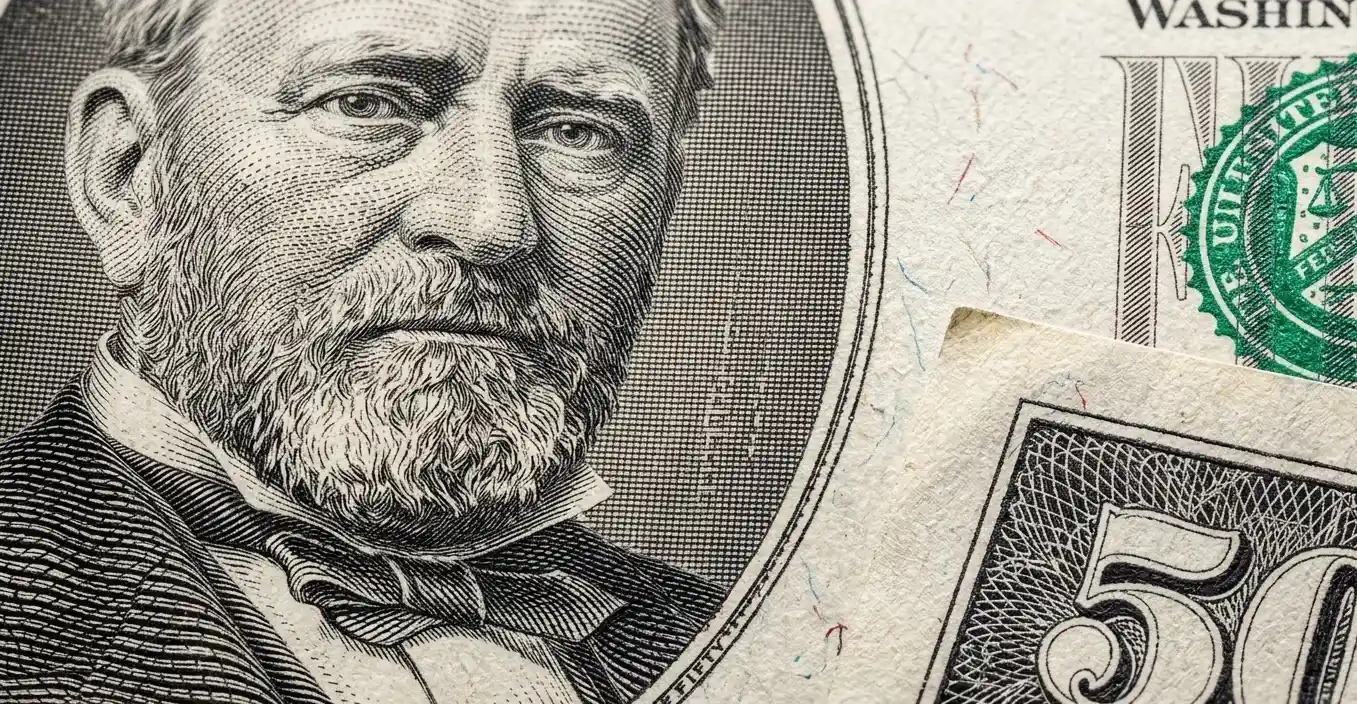
Circulating volume for this denomination remains significantly lower than that of $1 or $100 notes.
US Treasury officials utilize this specific unit to implement advanced anti-counterfeiting technological solutions.
Characteristic | Modern Note Parameters |
Length | 155.956 mm |
Width | 66.294 mm |
Mass | 1.00 grams |
Material Blend | 75% Cotton, 25% Linen |
Primary Colors | Pink, Blue, Yellow |
Paper Thickness | 0.11 mm |
Lacking wood pulp in its structure allows the paper to withstand up to 4,000 double folds.
Integrating blue and red security fibers into the paper occurs during the sheet-casting stage.
Uniform fiber distribution across the entire surface prevents high-quality scanning or copying.
Hierarchy of Anti-Counterfeiting Systems
Equipped with a multi-level complex of authenticity features, the modern $50 bill resists falsification.
Verification happens through visual inspection or specialized banking equipment.
Primary Security Elements:
Security Thread: A vertical plastic strip inscribed with USA 50 and a flag image.
Watermark: A duplicate Grant portrait visible when held to light on the right side.
Color-Shifting Ink: The numeral 50 in the lower right changes from Copper to Green when tilted.
Microprinting: Text reading FIFTY and USA 50 located inside side stars and on Grant’s collar.
Background Patterns: Intricate blue and pink lines formed by guilloche machines.
Light direction → Reflection from metallic ink particles → Optical density change.
Ultraviolet light causes the security thread to glow yellow.
Observing this effect remains a critical step for quick verification in retail environments.
Production Metrics and Mintage Volume
Annual currency printing plans are formed by the Bureau of Engraving and Printing based on Federal Reserve demand.
Printing volumes for $50 notes fluctuate depending on economic needs.
Yearly Production Statistics:
2021: 131,200,000 units
2022: 240,640,000 units
2023: 115,200,000 units
2024: 163,800,000 units
Total cash mass for this denomination in 2026 is estimated at $105 billion.
Low circulation intensity extends the average lifespan of a note to 12 years.
Comparing to a hundred-dollar bill → Active usage period for 50 dollars is 25% longer.
Value and Collector Market
Secondary market pricing for banknotes depends on rarity, condition, and unique serial numbers.
Standard modern notes trade at their face value.
Rare series and specimens from past decades show steady price appreciation.
Market Indicators for Rare Series:
1928 Series (Choice Uncirculated 64): $450
1950 Series with rare district seals: $115
Modern "Star" notes: $75
Cutting or paper-jam errors: $200 to $1,200
And scan via a free coin scanner app to know for sure
Value growth for rare $50 notes over the last 10 years: 2016–2020: +3% annually → 2021–2026: +7% annually.
Rising demand for physical assets in 2025 pushed prices for Gem Uncirculated 65 notes up by 12%.
Investment value concentrates in banknotes holding PMG or PCGS Banknote certification.
Lacking visible signs of circulation ensures capital preservation.
Obverse Design and Symbolism
President Grant's portrait, originally by artist Henry Gugler, underwent significant revision in 2004.
Increasing the image size allowed for adding fine details that protect against digital scanning.
Front Side Elements:
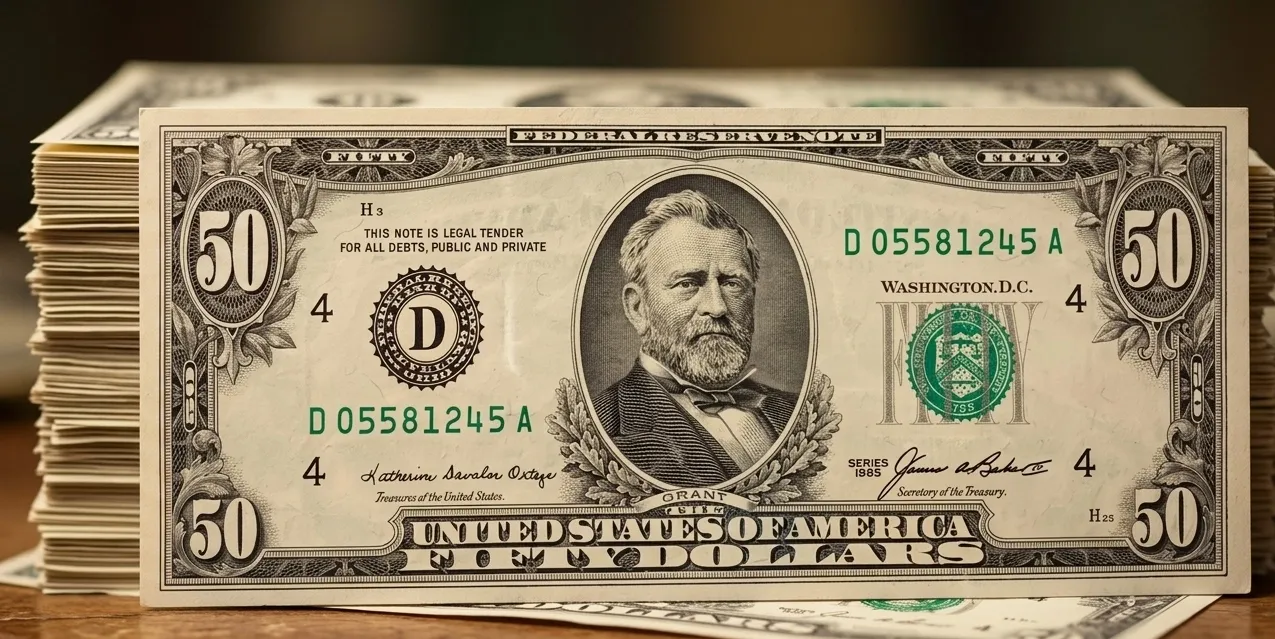
Federal Reserve Seal: Black ink, located to the left of the portrait.
Treasury Seal: Green ink, located to the right of the portrait.
Serial Number: An 11-character combination unique to every note.
Identification Letters: Pointing to the specific issuing bank.
Using intaglio printing creates a felt relief on the President’s clothing.
Running a fingernail across the collar allows one to feel the characteristic roughness.
Smooth surfaces in this zone indicate a low-quality counterfeit.
Reverse Features and Architectural Details
Depicting the West Front of the US Capitol in Washington, the back side serves as a focal point.
Engraving methods used for this image require high master qualification.
Detailing the Illustration:
Capitol Dome: Central landmark with clearly defined columns.
Surrounding Landscape: Trees and paths creating compositional depth.
Inscribed "IN GOD WE TRUST": A mandatory element of US currency.
Large Numeral 50: High-contrast font designed for the visually impaired.
Using yellow color in the reverse background complicates color separation during copy attempts.
Strict centering defines the placement of all elements.
Symmetry violations exceeding 1 mm indicate production flaws or falsification.
Counterfeit Detection Methods
Faking technologies for paper money continue to evolve.
Banking security services in 2026 are shifting toward spectral analysis usage.
Reasons for Note Rejection:
Incorrect UV glow: The thread must be yellow; the paper must remain dark.
Blurred microtext: USA 50 characters must be legible via the best coin identifier app.
Missing relief: Counterfeits often possess a completely flat surface.
Serial number mismatch: Usage of identical numbers across different sheets.
Verification sequence: Surface → Relief → Thread → Watermark → Optical Ink.
Using IR-sensor currency detectors allows for seeing "invisible" marks.
Genuine $50 notes possess specific absorption zones in the infrared spectrum.
Collectible Serial Number Categories
Numismatic value for modern banknotes often depends on the digit sequence.
Serial number hunters pay significant premiums over face value.
Number Type | Description | Estimated 2026 Price |
Ladder | 12345678 or reverse order | from $800 |
Radar | Reads the same forwards and backwards | $150–$300 |
Low Number | Below 00000100 | $250–$600 |
Solid | All eight digits are identical | from $2,000 |
Binary numbers consisting of only two digits are valued 40% higher than regular ones.
Increased interest in modern notes in 2024 caused a shortage of "star" bills in bank packs.
Stars at the end of a serial number indicate replacement sheets used during printing.
Finding such a note in a pack happens approximately 1 in 3,000 times.
Evolution of Note Design
Historical changes in the 50-dollar appearance reflect national technological progress.
Every modification aimed to complicate the note's structure.
Transformation Timeline:
1928–1990: Classic small portrait, no security thread.
1990–1996: Introduction of plastic threads and microprinting.
1997: Significant enlargement and off-centering of Grant's portrait.
2004–Present: Addition of colors, watermarks, and modern optical elements.
Abandoning the black-and-white palette helped reduce the effectiveness of monochrome copiers.
Implementing pink and blue hues complicated the ink-matching process.
Every new generation becomes lighter in mass but denser in security features.
Legal Status and Older Series Circulation
All $50 notes issued since 1861 remain legal tender.
US Government policy has never invalidated old currency issues.
Using series prior to 1990 for daily transactions is not recommended.
Exchanging old notes for new ones occurs at any commercial bank at face value.
Market prices for old specimens in good condition always exceed their face value.
Handling Guidelines for Old Series:
Exclude them from daily spending.
Place them in protective note holders.
Evaluate preservation using professional standards.
Consult an authorized dealer for realization.
Inflation reduces the purchasing power of $50, but numismatic rarity grows.
Annual reduction in the number of surviving notes from 1934–1963 series averages 2%.
Securing stable price growth for investors remains the primary result.
Future of the 50 Dollar Note and Digitalization
Discussions regarding the next generation occur under the "Advanced Counterfeit Deterrence" program.
Radical design changes are expected by 2030.
Predicted Modifications:
Integration of tactile marks for the blind along the edges.
Usage of 3D security ribbons similar to the $100 note.
Potential portrait changes to reflect a wider range of historical figures.
Applying polymer materials to increase service life.
Shifting to a plastic base → Reducing printing costs by 15% in the long term.
Environmental requirements push for using recyclable materials.
Despite rising digital payments, demand for physical $50 bills remains stable.
Storage Rules and Condition Grading
Paper degradation leads to irreparable losses in collectible value.
Professional collectors utilize specialized equipment.
Risk Factors:
Humidity: Causes mold growth and "foxing" spots.
Light: UV rays destroy ink pigments.
Acidity: Contact with regular paper or cardboard causes yellowing.
Mechanical Damage: Folds and tears drop grades from 60 down to 20.
Perfect Uncirculated 70 condition is extremely rare for $50 notes.
Most 2026 auction lots fall within the 64–66 point range.
Price differences between 66 and 67 grades can reach 300%.
Element | Visual Sign | Technical |
Portrait | Clear, 3D effect | Felt relief on the shoulder |
Serial Number | Matching font and color | Characters pressed into paper |
Security Thread | Visible when back-lit | Glows yellow in UV light |
Paper | No UV glow | Distinct crisp sound |
50 Ink | Changes Copper to Green | No ink flaking |
Knowing these facts ensures the safety of financial operations.
The $50 bill remains a symbol of reliability and US technological leadership.
Sophisticated design and complex protection ensure its necessity in the global economy.
Interest from researchers and investors toward this banknote continues to grow.